How to Clean Lead Aprons


Cleaning your lead apron the right way protects two things: your patients and your investment. The wrong cleaner can crack the outer shell, degrade the lead barrier, and void your warranty. The right cleaner takes 60 seconds per apron and keeps your aprons performing for their full service life.

This is INFAB’s official cleaning procedure for Revolution and Classic lead aprons — the same procedure shown in the video below.

The 4-Step INFAB Cleaning Procedure

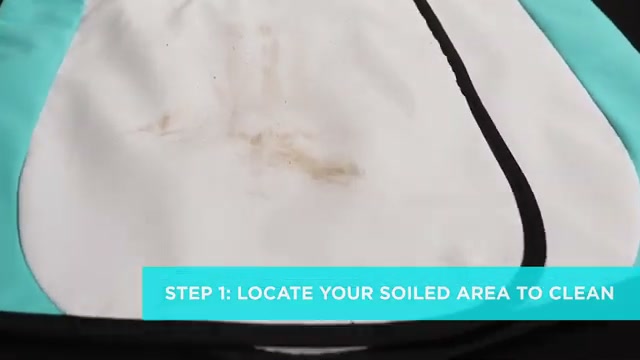
STEP 1: Locate your soiled area to clean - INFAB lead apron cleaning

1. Locate the soiled area

Inspect the apron and identify any contaminants — barium, blood, iodine, contrast medium, skin oils, or general soil. Wipe or wash off aggressive contaminants (vomit, blood) promptly to minimize permanent chemical-attack effects. Fresh contamination wipes off cleanly; dried contamination may require extra contact time to rehydrate.

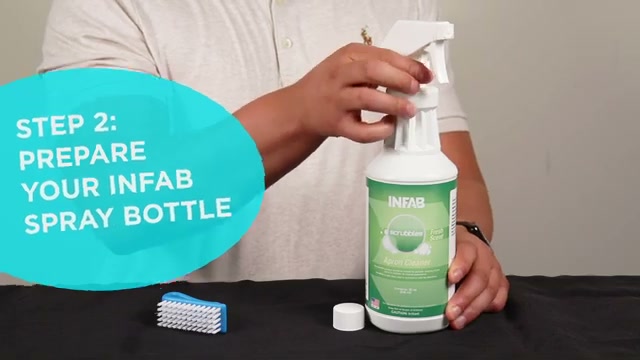
2. Prepare your INFAB Revolution Scrubbles spray bottle

Revolution Scrubbles (Model 683447, 32 oz) is INFAB’s purpose-built lead apron cleaner. It’s formulated to safely lift barium, blood, and other radiology stains from apron fabrics. Have a soft-bristle brush and a clean damp cloth ready.

STEP 2: Prepare your INFAB Revolution Scrubbles spray bottle
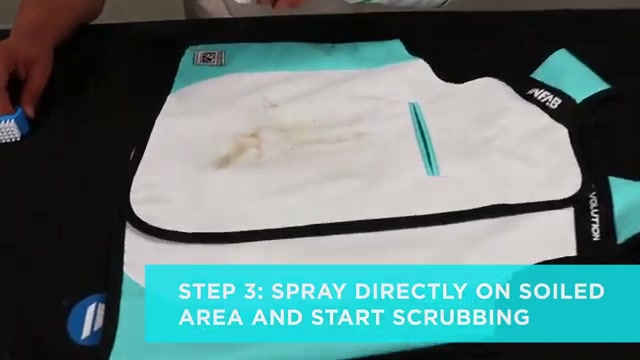
STEP 3: Spray Scrubbles directly on soiled area and start scrubbing

3. Spray, let stand, scrub, rinse

Apply Scrubbles directly to one section of the apron at a time. Let it stand for a few minutes — but do not let the cleaner dry before rinsing. Scrub with a soft-bristle brush in gentle circles. Rinse the section with water and a damp cloth. Move to the next section.

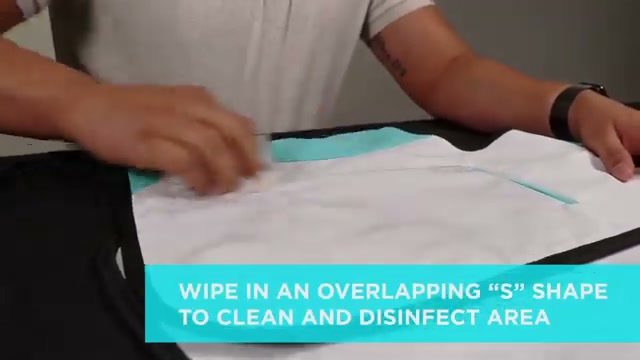
4. Disinfect with Clorox Hydrogen Peroxide

Use Clorox Hydrogen Peroxide Cleaner Disinfectant Wipes (or the spray version with a soft cloth). Wipe in an overlapping “S” shape across the cleaned area to fully disinfect. Clorox Hydrogen Peroxide is an EPA-registered disinfectant — follow the product label for contact times (30 seconds to 3 minutes depending on the organism).

Repeat steps 3 and 4 until the entire apron is clean and disinfected.

Wipe in an overlapping S-shape pattern to clean and disinfect lead apron

INFAB-Recommended Cleaning Products

INFAB-recommended cleaning products: Clorox wipes, Revolution Scrubbles, Clorox spray

These products are tested and recommended by INFAB for use on Revolution, Classic, and Lightning lead aprons:

Revolution Scrubbles Lead Apron Cleaner

Purpose-formulated for radiology stains — barium, blood, contrast medium. Citrus scent. 32 oz bottle (Model 683447) or case of 12 (Model 683448).

Clorox Hydrogen Peroxide Disinfectant Wipes

EPA-registered disinfectant. Safe for use on apron fabrics. Use after Scrubbles cleaning to disinfect — follow product label for contact times.

Clorox Hydrogen Peroxide Disinfectant Spray

Spray application of the same disinfectant. Use with a soft cloth or directly on apron surfaces. Hold 6″-8″ from surface and apply in a smooth zigzag motion.

How Often to Clean

Cleaning frequency depends on your facility’s infection-control policy. As a general rule: clean immediately after any contamination event (bodily fluids, contrast medium, iodine), and follow your facility’s between-patient and end-of-shift cleaning protocols. High-volume interventional environments typically require more frequent disinfection than diagnostic imaging settings.

Fresh contamination cleans easily; dried contamination is harder to remove and more likely to cause permanent staining — so address spills promptly.

Cleaners That Will Damage Your Lead Apron

INFAB recommends Revolution Scrubbles for cleaning and Clorox Hydrogen Peroxide for disinfection. The following are not recommended for routine apron care:

  • Bleach — INFAB does not recommend bleach for routine apron cleaning. The Buyer’s Guide recommends Clorox Hydrogen Peroxide instead.
  • Alcohol-based disinfectants for routine broad-area cleaning — INFAB does not recommend alcohol as a primary cleaner. Spot use of rubbing alcohol to remove dried Betadine residue is acceptable.
  • Glutaraldehyde liquid sterilants — incompatible with apron fabrics
  • Acids of any kind — chemical attack on the outer shell and core
  • Iodine solutions (Betadine) for broad-area cleaning — extreme staining; use only for incidental contact, and wipe off promptly
  • Detergent cleaners with hydrocarbon solvents (butyl acetate, acetone) — dissolves apron materials
  • Detergents used at higher than the manufacturer’s recommended concentration — can strip plasticizers from apron coatings over time
  • Ammonia solutions — can turn certain plastics greenish
  • Steam or water above 150°F — warps materials and degrades seams
  • Machine washing or full submersion — destroys core integrity, ruins velcro and stitching
  • Stiff brushes, abrasive pads, sharp scrapers — mechanical damage to the outer shell

Warning: Using non-recommended products may void your INFAB apron warranty. When in doubt, contact INFAB customer service at 805-987-5255.

Storage

Store your lead apron flat or on a dedicated lead apron hanger to avoid creasing. Folding or hanging on a standard hanger creates stress points where the inner core can crack — a crack you can’t see, but that compromises radiation protection.

  • Keep aprons in a cool, dry place
  • Avoid direct sunlight
  • Don’t drape over chair backs or pile in storage bins
  • Use INFAB lead apron racks or hangers designed for the weight

Inspection

Lead aprons must be inspected regularly for cracks, tears, thinning, and fastener wear. A cracked core is invisible from the outside — but it leaks radiation through the gap.

Check before each use:

  • Outer fabric for tears, punctures, or cracking at seams
  • Inner core for thin spots (feel through the fabric)
  • Velcro closures and shoulder fasteners for secure operation
  • Stitching for unraveling

Most facilities also conduct a formal inspection at least annually, or per your state radiation control program’s requirements. The standard inspection method is fluoroscopy or radiography to verify the integrity of the attenuating core; visual and tactile inspection is also a valid component of routine inspection programs (per AAPM guidance).

Track your inspections with Smart Track. INFAB’s web-based apron tracking system logs every garment, every inspection, and every maintenance event in one place. Visit smarttrack.infabcorp.com to learn more.

When to Replace

Replace your lead apron immediately if:

  • Inspection reveals any crack, tear, or hole in the outer shell
  • The inner core has any visible thin spot or crack
  • Fasteners no longer hold the apron securely in place
  • Stitching has come undone at structural points (shoulder, side seams, hem)

Service life varies with use intensity and care. Replace immediately when inspection reveals defects (cracks, tears, thin spots in the core, failed fasteners). With proper cleaning and storage, well-maintained aprons commonly remain in service for many years; high-volume daily use shortens service life.

Frequently Asked Questions

How often should I clean my lead apron?

For high-volume environments (cath lab, IR, OR), wipe down between each patient with INFAB Scrubbles or Clorox Hydrogen Peroxide. For standard radiology, weekly cleaning is sufficient. Always clean immediately after any contamination — bodily fluids, contrast medium, or iodine.

Can I use bleach or alcohol on a lead apron?

INFAB does not recommend bleach or alcohol as primary cleaners. Use Revolution Scrubbles for routine cleaning and Clorox Hydrogen Peroxide for disinfection — both are recommended by INFAB. Rubbing alcohol can be used as a spot treatment for dried Betadine residue.

What’s the right way to remove blood or iodine stains?

Wipe Betadine off promptly during clinical use — incidental contact generally won’t stain if cleaned right away. For fresh blood or stains, apply Scrubbles directly to the area, let it stand a few minutes (but don’t let it dry), then scrub with a soft-bristle brush and rinse with water and a damp cloth. For dried Betadine, wipe with rubbing alcohol applied to a soft cloth. Never scrub Betadine with water-based cleaners — it will spread the stain.

Can I machine wash a lead apron?

Never. Machine washing destroys the inner attenuating core, ruins the velcro closures, and degrades the seams. All cleaning must be done by hand. Full submersion is also not recommended.

How long does an INFAB lead apron last with proper care?

Service life varies with use intensity and care. With proper cleaning and storage, well-maintained aprons commonly remain in service for many years. Annual inspection determines actual replacement timing — replace immediately if inspection reveals any crack or tear.

What if my apron has a crack or tear?

Take it out of service immediately. A crack in the outer shell or core compromises radiation protection — even a small one. Contact INFAB customer service at 805-987-5255 about repair (when possible) or replacement.

Where can I buy Revolution Scrubbles?

Order directly from INFAB at infabcorp.com or contact your INFAB sales representative. Scrubbles is sold as a 32 oz bottle (Model 683447) or case of 12 (Model 683448).
Related INFAB Resources

Back To Top
Search