
Imagine a future where artificial intelligence (AI) helps radiologists detect breast cancer earlier, faster, and with greater accuracy, while also reducing unnecessary stress for patients. Thanks to a groundbreaking study from researchers at Microsoft and the University of Washington, that future may be closer than we think.
The Challenge: Finding a Needle in a Haystack
Breast MRI is one of the most sensitive tools for detecting cancer, especially in women at high risk. But it comes with a big challenge: false positives. These are cases where the scan looks suspicious but turns out to be harmless, leading to anxiety, extra tests, and sometimes unnecessary procedures.
Traditional AI models have tried to help, but they often struggle in real-world screening settings where actual cancer cases are rare. Plus, many of these models are “black boxes”, making predictions without showing how or why, which makes it hard for doctors to trust them.
The Breakthrough: An Explainable AI Model
The new study introduces a smarter, more transparent approach. Researchers developed an “anomaly detection” AI model that learns what healthy breast tissue looks like and flags anything that seems unusual. Think of it like a highly trained assistant that knows what “normal” is and raises a hand when something doesn’t fit.
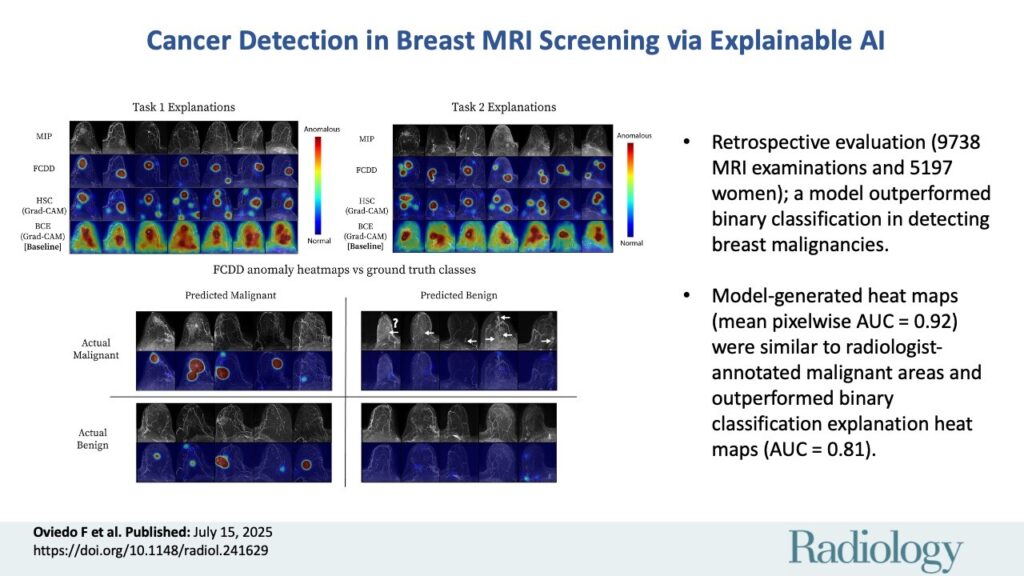
Even better? This model doesn’t just say “something’s wrong”, it shows where the problem might be using easy-to-read heat maps. These visual cues help radiologists quickly focus on the areas that matter most.
Real Results, Real Promise
The model was tested on nearly 10,000 breast MRI scans and compared to traditional AI methods. The results were impressive:
- Higher accuracy in both high-risk and routine screening scenarios
- Fewer false alarms, which could reduce unnecessary follow-ups
- Clearer explanations, making it easier for doctors to trust and use the AI
In fact, the model’s visual maps were nearly as accurate as expert radiologists in identifying cancerous areas.
Smarter Screening, Safer Patients
At INFAB, we believe that healthcare should always put people first. That means embracing technologies that not only improve accuracy but also reduce unnecessary exposure and stress. While breast MRI doesn’t involve ionizing radiation like X-rays or CT scans, the broader message is clear: early detection saves lives, and safer, smarter tools help healthcare providers deliver better outcomes.
This new AI model is a powerful example of how innovation can support that mission. By helping radiologists detect cancer earlier and more confidently, it brings us one step closer to a future where every patient gets the care they need, when they need it, with as little risk as possible.
As AI continues to evolve, INFAB remains committed to supporting technologies that align with our core values: protecting patients, empowering providers, and advancing health-first innovation.
