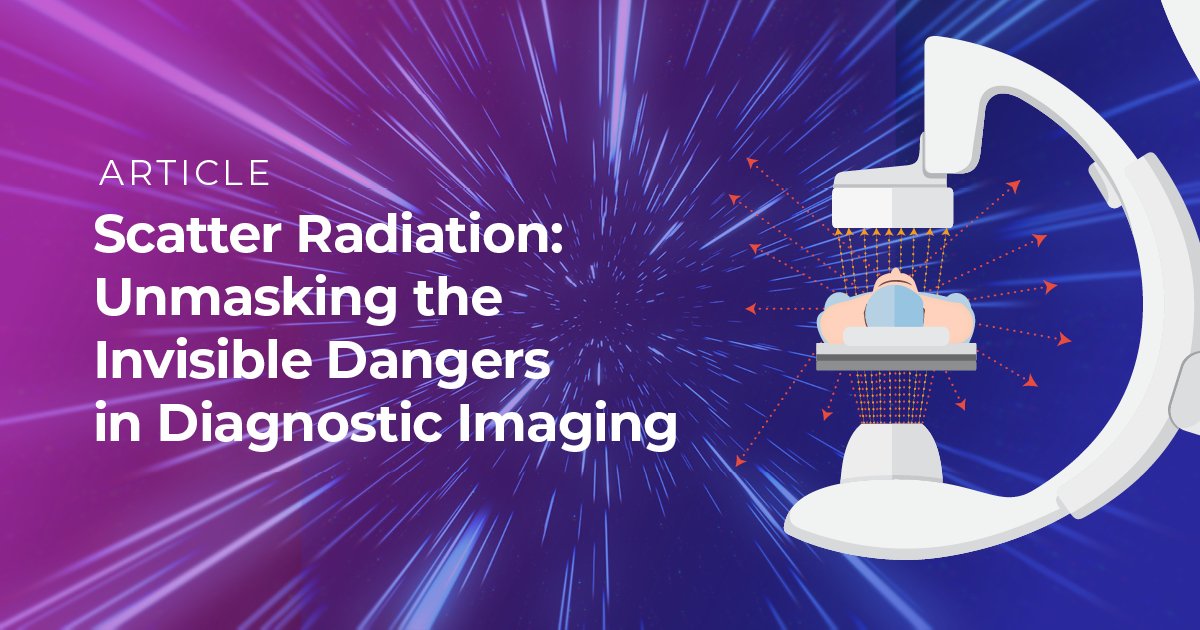
Radiation has undoubtedly revolutionized the medical field, especially with the advent of X-rays. Yet, with innovation comes responsibility; understanding the intricacies of radiation, especially its potential dangers, is of paramount importance. Navigating the intricacies of cutting-edge imaging technology and safety measures is a challenging endeavor. In this realm, we encounter the nuances of scatter radiation and the continuously advancing protective apparel, ensuring the safety of both patients and medical professionals.
Direct Beam vs. Scatter Radiation
A common misconception in the realm of medical imaging is the belief that radiation, once emitted, follows a single, unobstructed path. In reality, radiation’s interaction with the human anatomy paints a more intricate picture.

Direct Beam Radiation
Imagine it as a focused stream of high-energy photons, intended to penetrate and traverse the patient’s body. Its primary goal? To provide a crystal-clear image of the patient’s internal structures. However, as these photons journey through, not all of them reach the imaging receptor without some form of interaction.
Scatter Radiation
The complex dance begins here. When direct beams interact with the patient’s tissues, certain X-ray photons lose energy, scattering and meandering in various directions. While some of these scattered photons can impact the clarity of the image, others rebound, potentially posing health hazards, especially to medical personnel in close proximity.
Exploring Radiation Interactions
The dialogue between X-rays and matter is not random; it’s a scientific interplay, predominantly governed by two chief phenomena.

Photoelectric Effect
Visualize an X-ray photon fully immersing itself within matter. During this process, the photon transfers all its energy to an atomic electron, compelling it to leave its orbit. While this interaction is more commonly associated with lower-energy photons, it has a noteworthy impact on the patient’s radiation dose and plays a crucial role in enhancing image quality.
Compton Effect
The primary contributor to scatter radiation, during this interaction, the X-ray photon only partially transfers its energy to an electron, causing its deflection and trajectory change. These diverted photons can either interact with other particles or exit the body.
Lead-Free Radiation Protection Material
Transitioning from the traditional lead-based materials, the domain of radiation protection is gravitating towards greener, more sustainable alternatives. Lead-Free exemplifies this shift with its pioneering lead-free solution.

At the heart of our lead-free material’s protection are two primary elements: Antimony (Sb) and Bismuth (Bi):
- Antimony and Low-Energy Photon Absorption: With a lighter atomic weight, Antimony is proficient at absorbing low-energy photons, especially those associated with the photoelectric effect.
- Bismuth and High-Energy Photon Mitigation: Possessing a greater atomic heft, Bismuth efficiently absorbs the high-energy photons, preventing deeper tissue penetration.
This synergistic combination of Antimony and Bismuth provides comprehensive protection across a broad spectrum of X-ray frequencies, ensuring a heightened level of safety for healthcare professionals.
The IAEA Statement and Adherence to Safety Standards
The International Atomic Energy Agency (IAEA) pronounced a critical reflection, emphasizing the gravity of scatter radiation: “The scattered radiation from the patient comprises the main source of radiation dose to staff.1” This affirmation starkly highlights the indispensable nature of scatter radiation protection.
Further testament to our unwavering commitment to safety is their strict adherence to international safety benchmarks, including DIN, IEC, and ASTM.
Advancing Medical Imaging: Balancing Innovation with Safety
In the vast landscape of medical imaging, bridging the gap between groundbreaking technology and optimal safety is a colossal task. Scatter radiation, a by-product of X-ray interactions with the body, brings its own set of challenges. Yet, with a profound understanding of these phenomena and the employment of state-of-the-art materials like our lead-free, we stride closer to a future where medical professionals are safeguarded, and sustainable radiation safety isn’t just a goal but a reality.
^1 “Radiation Protection of Medical Staff in Interventional Fluoroscopy.” International Atomic Energy Agency (IAEA). https://www.iaea.org/resources/rpop/health-professionals/interventional-procedures/radiation-protection-of-medical-staff-in-interventional-fluoroscopy.
Correction Notice (10/26/23)
We would like to correct inaccuracies in our article “Scatter Radiation: Understanding the Hidden Hazards in Diagnostic Imaging,” published on October 25, 2023:
- We have clarified the roles of the Photoelectric Effect and the Compton Effect in medical imaging for accuracy.
We apologize for any confusion and remain committed to providing accurate information.
